AI implementation for service businesses

Let's implement AI and automation to make your business run smoother.

Quoting, intake, follow-up, reporting. I map the work, implement the system, leave it running in your team's hands, and stay on to keep it fitting.

The problem

From scattered inputs to one connected flow.

So the business runs the system, not the other way around.

Manual & scattered

Pieces of the workflow live in too many places.

Working system

The next step has a clear place to go.

EmailsIntake formsCRMQuote sheetsContentFollow-up
Working systemNext step clearDashboard currentFollow-up queued

Selected work

Working software that saves real businesses time.

Every preview is the real interface: some run in production today, the rest are demos with names and rates changed. Two of them you can open right now.

Client intake and calculation systemIn production

A dense client questionnaire, delivered as a review-ready brief.

  • The practice stops retyping intake answers; every submission arrives scored, in the right inbox
Open the interactive demo

Synthetic content · nothing is stored
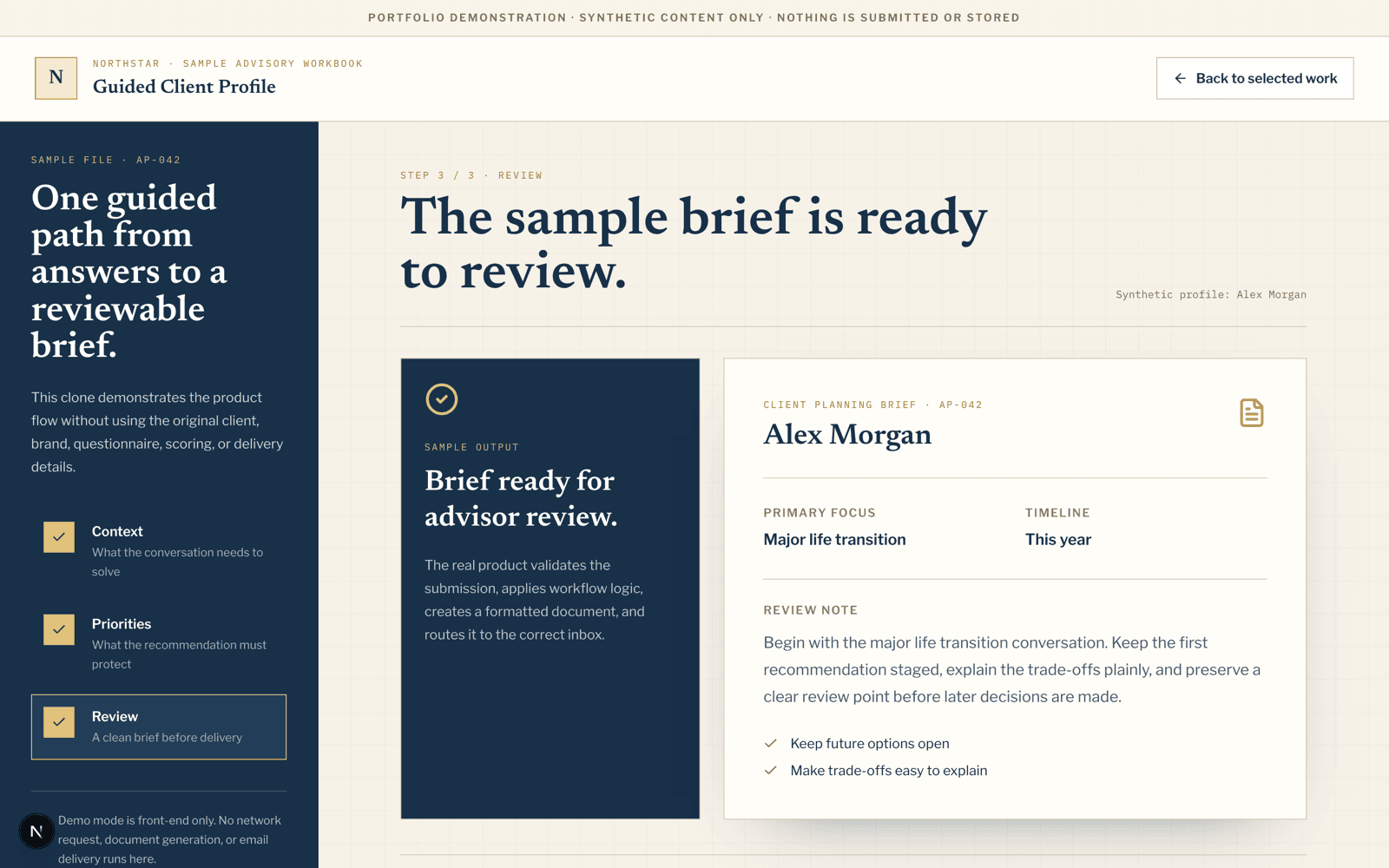
Generated advisory brief for a synthetic client profile in the CPQ demo
Generated brief · synthetic contentFIG. 02.1

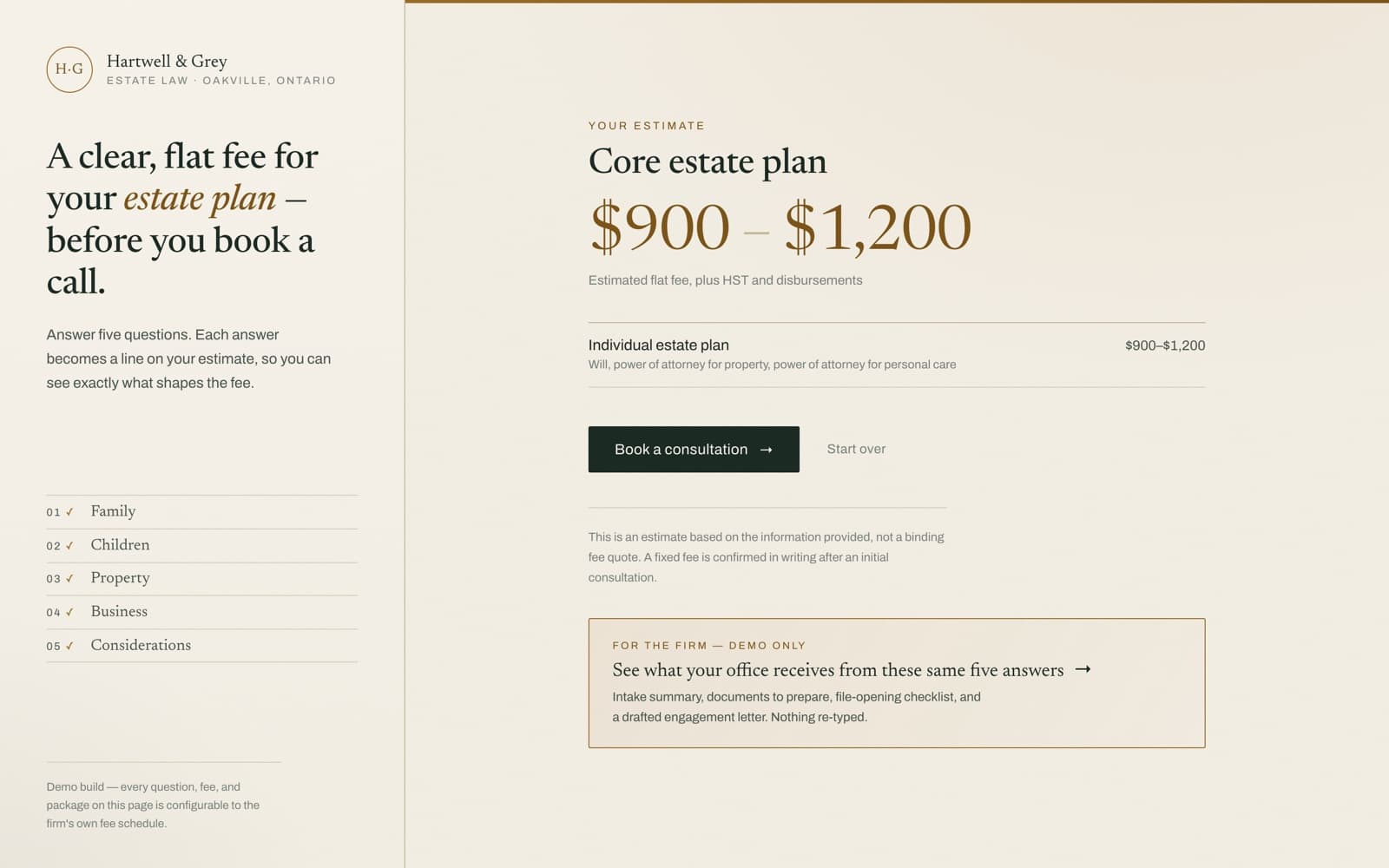
Estate-law quotingWorking demo

Five questions. A client quote, and the office file already drafted.

  • Clients see a real number before they book, and the office file drafts itself
Try the live demo

Fictional firm · nothing is stored

Client-facing flat-fee estate plan estimate screen from the demo
Client estimate · fictional firmFIG. 02.2

Employment CRMIn production

A placement pipeline with no client names in it, by design.

  • One pipeline from employer outreach to retention, safe to open in front of anyone
Private client system · walkthrough on request
Recreated screen · synthetic dataFIG. 02.3

How it works

Start with a Blueprint, or skip straight to the work.

No proposals, no packages to decode. One published price for the Blueprint, and a flat quote for whatever the work turns out to be.

Where most people start

The Working Blueprint

$495

One week on the job that eats the most of your week, before anyone commits to building anything.

  • A map of how the work actually happens today
  • A straight answer on custom versus configuring what you already own
  • Something you can click through, with your own rates and language in it
  • A written scope with a flat price for the work

Go ahead and the full $495 comes off that price. Don't, and the map, the working piece, and the scope are yours to keep, or to hand to another builder.

It is not a gate. If you already know what you want built, skip it and we'll scope the work on the call.

How I help

None of these need a Blueprint first. It is just the fastest way to find out which one you are looking at.

  • When nothing off the shelf fits

    Custom builds

    Software written for the way your business already works.

    • A quote calculator, an intake app, or an automated follow-up path
    • Flat price, fixed in writing before you commit
    • Live in weeks, documented, and your team walked through it
    • A small monthly minimum after handoff, so it keeps fitting
  • When the software already exists

    Setup on tools you already own

    Sometimes the software is already sitting there and nobody has made it fit.

    • Configured around how your team actually works
    • Connected to the tools you already run on
    • No new licences you don't need
    • Your team shown how to run it before I leave

Yours outright: code, accounts, data, documentation. No lock-in.

For some businesses one system is all they need, and I keep it running. For others it's the start, and over time I end up implementing and running more of it: quoting, intake, follow-up, reporting, one piece at a time. The first project is how we both decide.

Matt Henderson

About me

Matt Henderson. One person, end to end.

Why work directly with me

About

You work with the person who builds it.

I'm Matt Henderson. There's no team behind this site. I take the intro call, I map the work, I write the code, and I pick up the phone after handoff. One person end to end is why the software fits how you actually work, and why it keeps fitting when the business changes.

No handoffs.

The person who maps the work is the one who builds it, ships it, and answers the phone after. Nothing gets lost between a salesperson and a delivery team, because neither exists.

Small and working beats big and pending.

I build the smallest tool that removes the job, get it live in weeks, and grow it from there. You see working software early, not a roadmap.

Running in production.

This is not a recommendation deck. The client intake and calculation system I built for a CI Assante advisory practice is live and supported today.

Matt Henderson seated in an office

Questions

What owners ask before the first build.

Straight answers, the same ones you get on the intro call.

Something I didn't cover?

Book the intro call

Service businesses that run on quotes, intake, and follow-up. If someone in your business spends evenings writing quotes, retyping the same client details, or chasing people who went quiet, that's who I build for. Industry matters less than those three jobs.

A week of my attention on one job in your business. Concretely: a map of how the work happens today, a straight answer on whether you need something custom built or the software you already own set up properly, something you can click through with your own rates and language in it, and a written scope with a flat price. If you go ahead, the $495 comes off that price in full. If you don't, everything I made is yours anyway.

Somewhere between $1,000 and $10,000, depending on what the Blueprint finds. The small monthly maintenance retainer is on top of that, and every engagement includes one. Wherever it lands, the number is fixed in writing before you commit, and the $495 comes off it in full.

That's part of the work, not a line item. When a system goes live I walk your team through the parts they'll actually touch, sit one-on-one with whoever wants it, and leave documentation written for the people doing the job rather than for another developer. Nobody gets handed a login and wished luck.

You own it, and your team is trained on it: how to operate it, how to maintain it, what to do if I vanish. If you want me to stay on, support is month to month, scoped to small changes as the business shifts. If you don't, the documentation is written so the next person can pick it up.

No. Code, accounts, data, and documentation are yours from handoff, and everything runs in accounts you control, not mine. Firing me is a one-line email, and the software keeps working the next morning.

Your accounts, your data. I build inside accounts you own and don't keep client information on my side. If your business has compliance rules, they go into the map during the Blueprint week, and how sensitive data is handled gets written into the scope before any build starts.

The next step is a call, not a proposal

Bring me the job that eats your week.

Thirty minutes. You describe how the work happens now, and I'll tell you what I'd tackle first and whether a $495 Blueprint makes sense. If it doesn't, I'll say so.